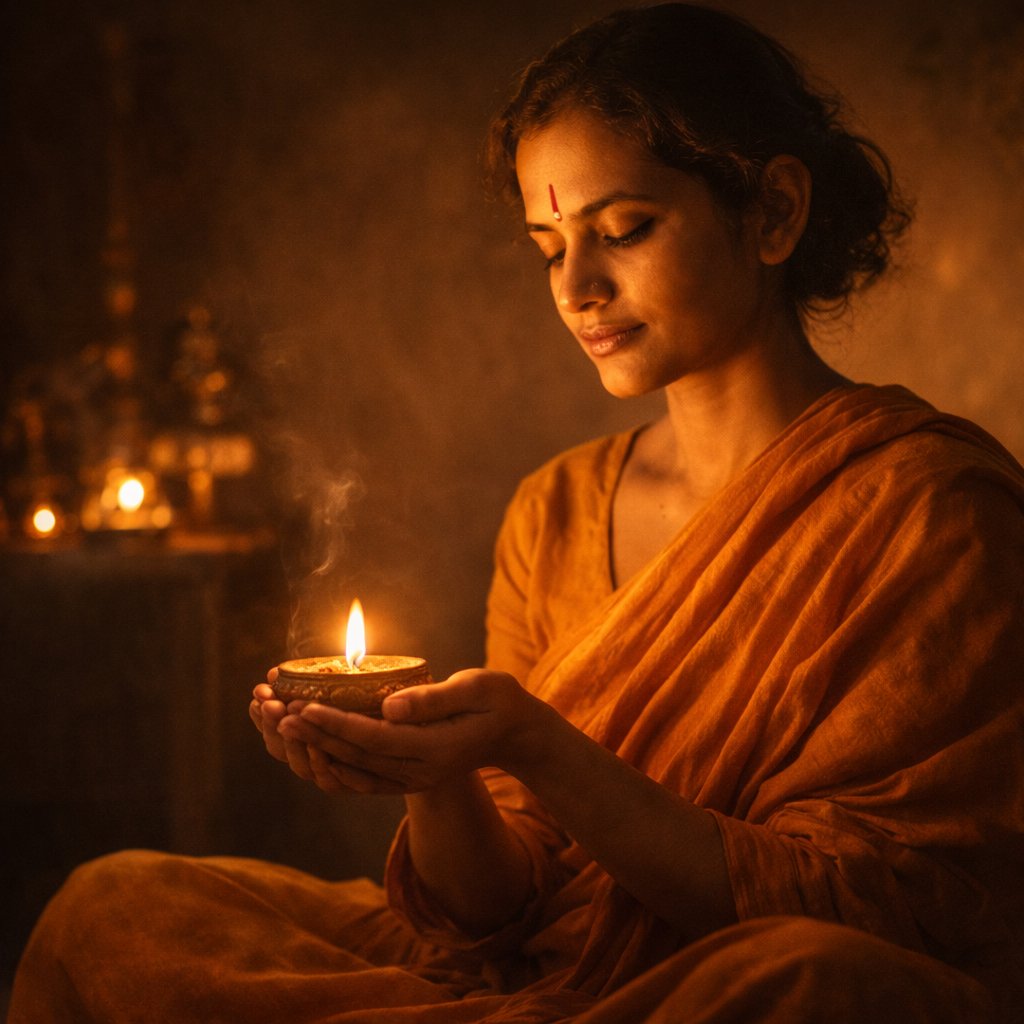
The Miraculous Birth
Sita was not born of a human mother. King Janaka of Mithila found her as an infant while ploughing the earth for a sacred ritual. She emerged from the ground in a golden vessel, a divine child, daughter of Bhoomi Devi (Earth Goddess), sent to the world to fulfil a cosmic purpose.
Her childhood in the palace of Mithila was marked by extraordinary qualities: deep wisdom, natural grace, and a strength of character that would be tested more severely than almost any figure in scripture. She mastered the sixty-four arts, studied the sacred texts, and was known throughout the kingdoms as a woman of exceptional virtue and beauty.
Sita's Choice: Devotion Without Condition
When Rama was exiled to the forest for fourteen years on his father's command, Sita refused to stay behind in the palace. Despite Rama's gentle insistence that she remain safe in Ayodhya, Sita spoke words that have echoed through Hindu consciousness for thousands of years: "The husband is the wife's God. Where you go, I go. I cannot remain behind."
This was not weakness or blind obedience. Sita was a princess of a great kingdom who chose the forest. She was the avatar of the Goddess of Fortune who chose poverty. She is the embodiment of pativrata dharma, not submission, but a fierce, chosen devotion that no suffering could break.
The Agni Pariksha
After Rama defeated Ravana and rescued Sita from Lanka, Rama, bound by the dharma of a king, asked Sita to prove her purity through the Agni Pariksha, the trial by fire. Sita stepped into the flames without hesitation. The fire god Agni himself emerged from the flames and declared Sita pure. She was returned to Rama untouched.
This episode is the most debated in the Ramayana. Many scholars see it as Rama's greatest failing, a moment where duty to his kingdom overcame his love for his wife. Sita's act itself is read as supreme spiritual mastery: she who was born of earth, who bore no ill will even in the fire, could not be harmed by flame.
Sita's Legacy
Sita is the most revered woman in Hindu tradition. Across India, the greeting "Jai Siya Ram" precedes "Jai Shri Ram" in many devotional traditions. Sita comes first. She is worshipped not only as Rama's consort but as Shakti, the divine feminine power that sustains the universe.
Her story is one of impossible dignity, a divine being who suffered deeply and yet never compromised her inner truth. The Sita of the Ramayana does not end in tragedy; she returns to her mother, the earth, and lives forever as the Goddess in the ground under our feet.
Ask DharmaChat AI
Explore deeper teachings, ask any question about Sita, and discover the wisdom of Sanatana Dharma.
Ask DharmaChat →