The Birth of Rama
Rama was born as the eldest son of King Dasharatha of Ayodhya, through a divine putrakameshti yajna performed by the sage Rishyashringa. He is Vishnu incarnate, the same Supreme Being who sustains the universe, born in human form to restore dharma to an earth threatened by the demon king Ravana.
From childhood, Rama displayed extraordinary qualities: perfect obedience to his parents, unfailing love for his brothers, total mastery of weapons, and an instinct for justice that never wavered. The sage Vishwamitra recognised him as the protector of dharma and took him to the forest to fight demons threatening sacred yajnas.
Rama and Sita
In the kingdom of Mithila, King Janaka held a swayamvara. The condition: any prince who could string the mighty Shiva Dhanush, a bow so heavy no ordinary man could lift it, would win his daughter Sita's hand. Rama not only lifted it; he strung it and broke it. Sita placed the garland around his neck. Their union is the ideal of love and marriage in Hindu tradition.
Sita is no passive partner. She is Mahalakshmi incarnate, the Goddess of Fortune and Virtue herself. When Rama was exiled to the forest for fourteen years on his father's command, Sita chose to follow him. "Where you go, I go. The forest with you is better than any palace without you." Her devotion is matched only by her strength.
The Exile and the War
Due to a boon granted to his stepmother Kaikeyi, Rama was exiled to the forest for fourteen years. Without protest, without anger, he obeyed his father's word. This acceptance is the heart of Rama's character, dharma above comfort, truth above desire.
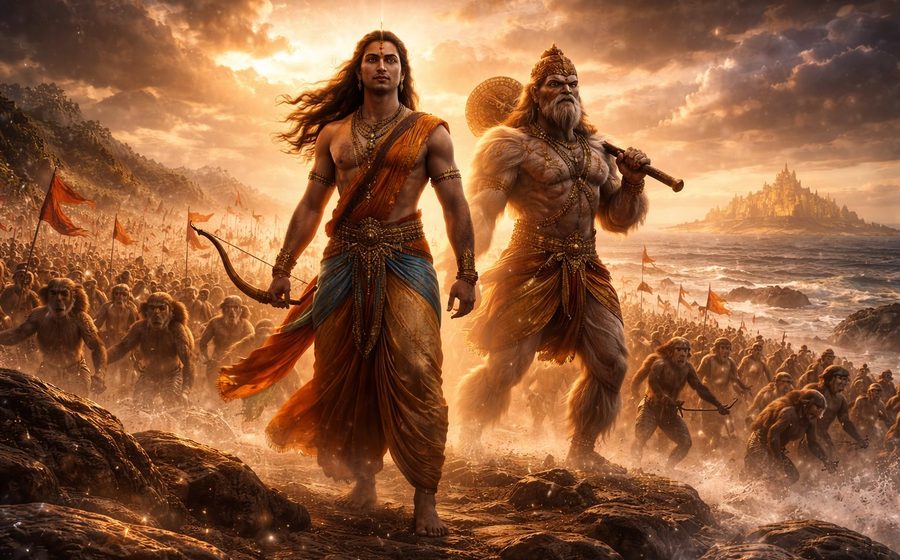
When Ravana abducted Sita and took her to Lanka, Rama built a bridge of floating stones across the ocean with the army of Vanaras led by Hanuman and Sugriva. The war that followed lasted many days and saw the deaths of Kumbhakarna, Indrajit, and finally Ravana. Rama killed Ravana not with hatred but with duty, restoring Sita and dharma to the world.
Rama as Ideal King
When Rama returned to Ayodhya after fourteen years, the people lit lamps to welcome him. This is the origin of Diwali. He ruled as the ideal king for eleven thousand years in what Hindus call Ram Rajya, the perfect kingdom where every person lived in righteousness, prosperity, and peace.
Rama is worshipped across India not merely as God but as the ideal human being. "Ram Ram" is the greeting exchanged between strangers on the road in much of India. His name, say the sages, contains all of the divine energy of the universe in its two syllables.
Ask DharmaChat AI
Explore deeper teachings, ask any question about Lord Rama, and discover the wisdom of Sanatana Dharma.
Ask DharmaChat →