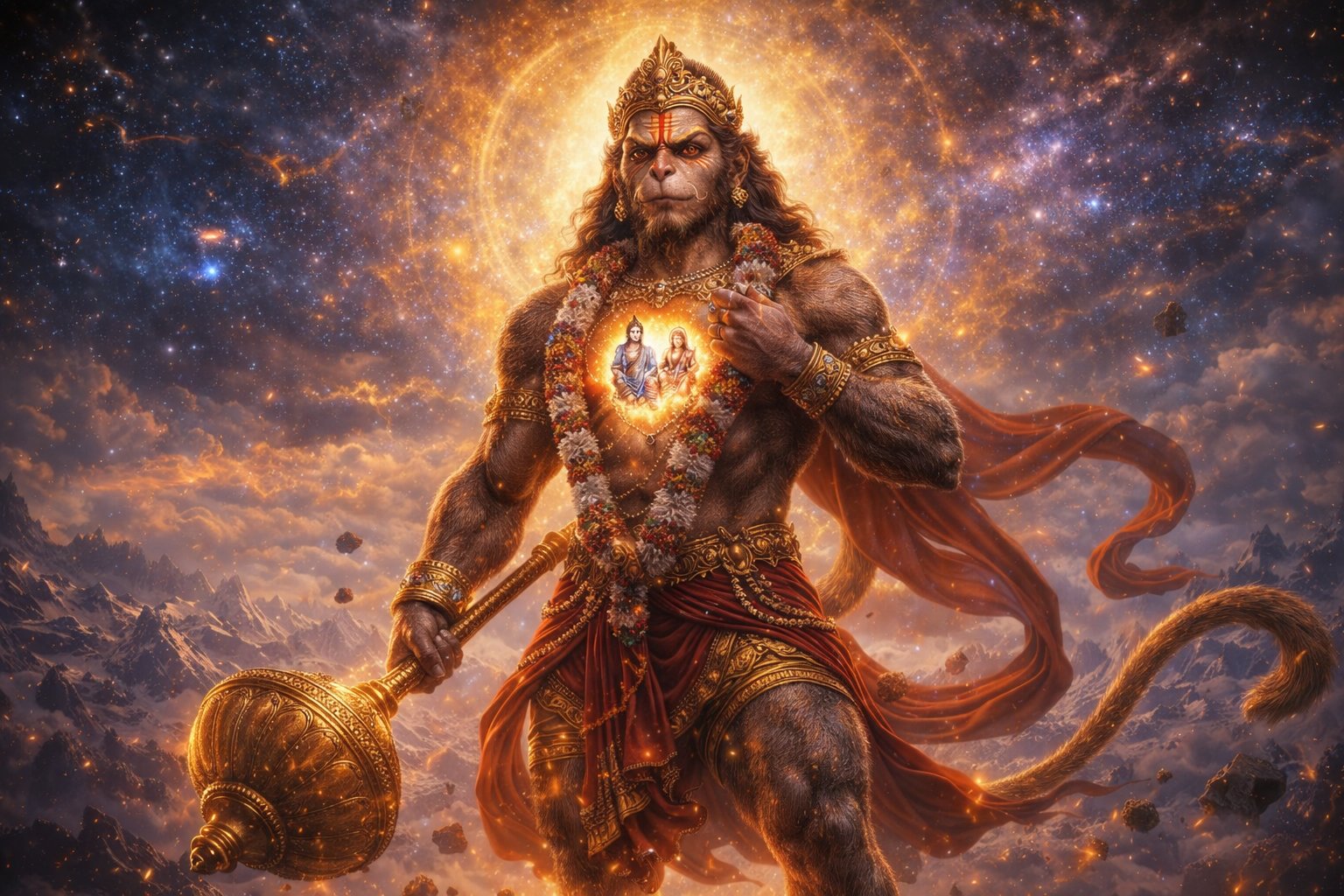
The Divine Birth of Lord Hanuman
Hanuman was born to Anjana, an apsara who had been cursed to take the form of a female monkey, and Kesari, the king of monkeys. However, his divine father is Vayu, the God of Wind. According to the Valmiki Ramayana, when Anjana was meditating on Mount Sumeru, Vayu carried the divine essence of Shiva's energy to her womb. This is why Hanuman is also called Vayuputra (son of the wind) and Shankar Suvan (son of Shiva).
At birth, Hanuman shone like blazing gold. He was so powerful that even as an infant, he mistook the rising sun for a ripe fruit and leaped into the sky to eat it. Indra hurled his thunderbolt to stop him, injuring Hanuman's chin. This is how he got his name: "Hanu" means chin or jaw in Sanskrit.
वातात्मजं वानरयूथमुख्यं श्रीरामदूतं शिरसा नमामि॥
Vatatmajam vanarayuthamukhyam Sriramadutam shirasa namami.
Hanuman's Extraordinary Powers and Abilities
Hanuman possesses eight supernatural powers (Ashta Siddhis) and nine forms of wealth (Nava Nidhis). He is one of the Chiranjivi, the immortals who remain alive until the end of this cosmic age (Kaliyuga). His powers include:
- Anima: the ability to become as small as an atom
- Mahima: the ability to become infinitely large
- Garima: the ability to become infinitely heavy
- Laghima: the ability to become as light as air and fly
- Prapti: the ability to be present anywhere instantly
- Prakamya: the ability to achieve any wish
- Ishtva: absolute lordship over creation
- Vashitva: the ability to control all beings
Yet despite possessing all these powers, Hanuman never uses them for personal gain. He uses them only in the service of Lord Rama. This is the hallmark of true divine power: it is always in the service of dharma, never for ego or self-interest.
Hanuman is also one of the most learned beings in creation. He is a master of all 64 arts (Chatushashti Kalas), a poet of the highest order, and the best grammarian. He is the author of a commentary on the Ramayana written in Sanskrit, said to be so perfect that even Valmiki wept when he read it.
Hanuman's Role in the Valmiki Ramayana
Hanuman first appears in the Kishkindha Kanda of the Ramayana. When Rama and Lakshmana are searching for Sita after her abduction by Ravana, they encounter the monkey king Sugriva and his minister Hanuman. Sugriva sends Hanuman disguised as a brahmin to test if the two strangers are trustworthy.
Hanuman immediately recognises the divine quality of Rama and Lakshmana. He reveals himself, takes them on his shoulders, and brings them to Sugriva. From this moment, Hanuman becomes the most trusted and devoted servant of Lord Rama.
After an alliance is formed between Rama and Sugriva, Sugriva's army of monkeys is dispatched in all four directions to search for Sita. The southern search party, led by Angada and including Hanuman, discovers that Sita is being held in Lanka, across the ocean.
The Search for Sita in Lanka
When the monkey army reaches the southern ocean, everyone despairs. The ocean is hundreds of miles wide, and no one claims to be able to cross it. One by one, the greatest warriors name their maximum jump: Angada 90 yojanas, Jambavan 90 yojanas. But Sita must be brought news of Rama, and the messenger must return with information.
Then Jambavan, the wise old bear, reminds Hanuman of his forgotten powers. At that moment, Hanuman's entire being transforms. He swells to his cosmic size, roars with divine energy, and leaps 100 yojanas (approximately 1,300 km) across the ocean in a single bound.
In Lanka, Hanuman searches the entire city in his tiny ant form. He finds Sita imprisoned in the Ashoka Vatika garden, surrounded by demonesses, thin and sorrowful but unbroken in her devotion to Rama. Hanuman approaches her, shows her Rama's ring as proof, and delivers Rama's message.
तेषां मे भवति प्रीतिः पार्थ नान्येन केनचित्॥
The Burning of Lanka and Return to Rama
After meeting Sita, Hanuman allows himself to be captured by Ravana's soldiers to deliver a direct warning to Ravana. Before being brought to court, Hanuman sits in Ravana's court on his own tail, elevated above the level of the throne, a supreme act of dignity that enrages Ravana.
Ravana orders Hanuman's tail set on fire as punishment. But Hanuman's divine nature cannot be harmed by fire. Instead, he uses his burning tail to leap from rooftop to rooftop, setting the entire golden city of Lanka ablaze. Lanka burns. Then Hanuman extinguishes his tail in the ocean, finds Sita again to reassure her, and leaps back across the ocean to Rama.
When Hanuman returns and tells Rama "I have found Sita," Rama embraces him with tears of joy. This moment, Rama embracing Hanuman, is considered one of the most sacred images in all of Hindu devotional art.
Hanuman's Devotion: The Model of Bhakti
Hanuman represents the highest ideal of Bhakti: pure, selfless, unconditional devotion to God. His love for Rama is not based on receiving anything in return. He asks for nothing. He expects nothing. He simply serves, with his entire being, every moment of his existence.
The story of Hanuman tearing open his chest to reveal Rama and Sita enshrined in his heart is one of the most powerful images of devotion in any spiritual tradition. When doubted about his devotion, Hanuman simply opens his chest. There, inscribed on his heart, are the names "Ram" and "Sita."
हनुमान की भक्ति अनन्य सदा
Hanuman ki bhakti ananya sada.
The saints of the Bhakti tradition, Tulsidas, Surdas, and Mirabai among them, all point to Hanuman as the perfect model of how to love God. Not with theological argument or ritual performance alone, but with the totality of one's being (body, mind, and soul) surrendered completely in love and service.
Why Hanuman is Worshipped for Strength and Protection
Hanuman is the presiding deity of physical strength, mental courage, and spiritual protection. He is worshipped by wrestlers, soldiers, athletes, and anyone facing great challenges. Tuesday and Saturday are especially sacred for Hanuman worship.
The Hanuman Chalisa, 40 verses in praise of Hanuman composed by the saint-poet Tulsidas in the 16th century, is recited by millions of Hindus every day. It is believed to destroy fear, remove obstacles, protect from evil, and fill the reciter with divine strength and confidence.
Hanuman is one of the eight Chiranjivi, immortals who remain alive until the end of Kaliyuga. It is said that wherever the Ramayana is recited, Hanuman is present, listening with tears of devotion in his eyes. He is as alive today as he was in Treta Yuga.
Hanuman teaches us that there is no limitation to what a devoted soul can achieve. He crossed the ocean not because of his physical power alone, but because of the power of Rama's name in his heart. When we chant "Jai Hanuman" or "Hanuman ki jai," we are not merely invoking a deity; we are connecting with the living principle of unstoppable devotion and divine strength that Hanuman embodies.
Jai Bajrangbali! Jai Shri Hanuman!