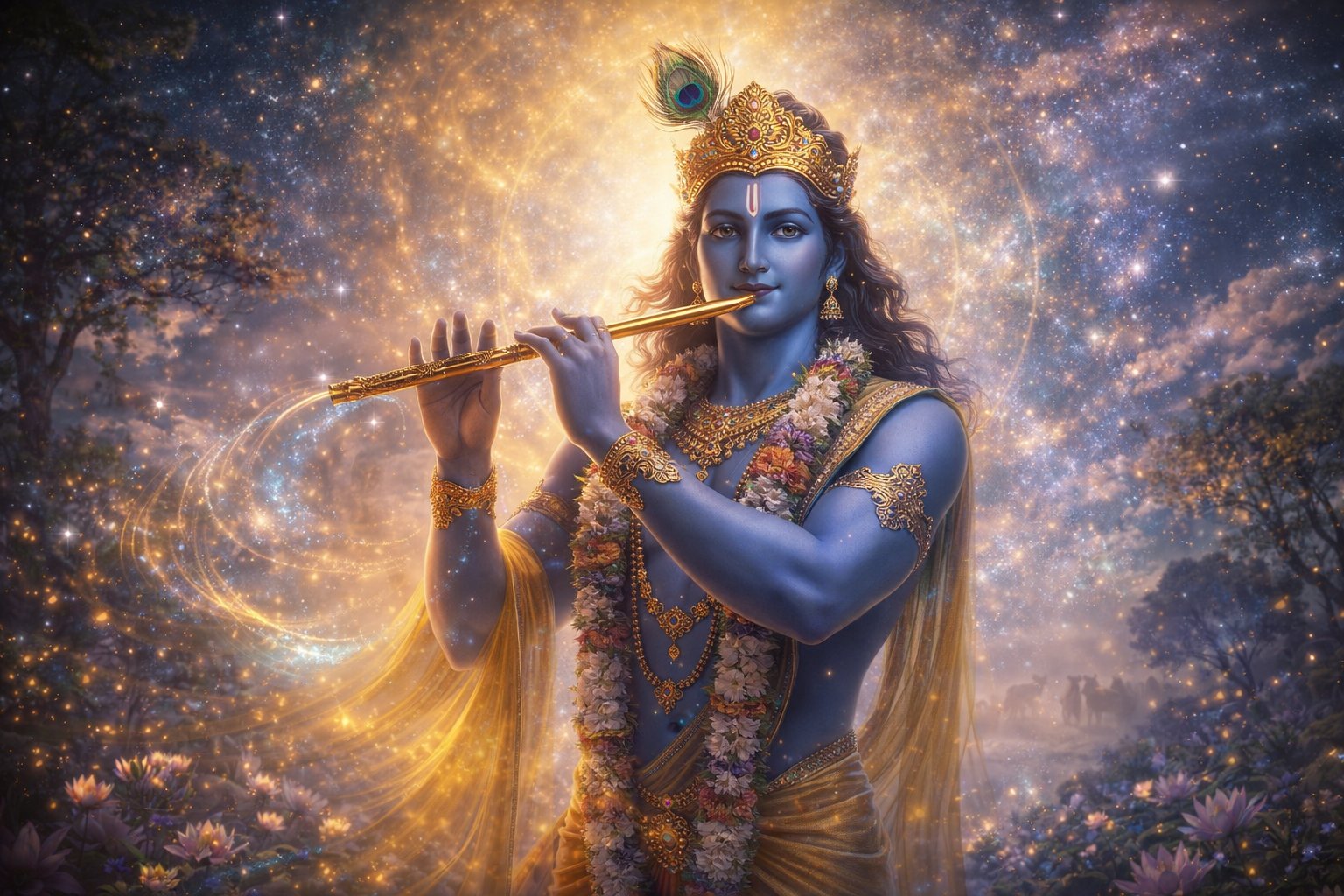
The Divine Birth of Lord Krishna
Lord Krishna was born in Mathura, in the prison cell of King Kamsa, to Devaki and Vasudeva. His birth is one of the most miraculous events in all of Hindu scripture. Krishna was born at midnight on the eighth day (Ashtami) of the dark fortnight in the month of Bhadrapada: a day celebrated globally as Janmashtami.
According to the Bhagavata Purana, when Devaki and Vasudeva were married, a divine voice from the sky declared that the eighth child of Devaki would kill the tyrant Kamsa. In terror, Kamsa imprisoned both Devaki and Vasudeva. He killed their first six children. The seventh, Balarama, was miraculously transferred to the womb of Rohini. When Krishna, the eighth, was born, the prison doors opened on their own, the guards fell into deep sleep, and Vasudeva carried the newborn Krishna across the Yamuna River to Gokul, where he was raised by the cowherd couple Nanda and Yashoda.
अभ्युत्थानमधर्मस्य तदात्मानं सृजाम्यहम्॥
Abhyutthanam adharmasya tadatmanam srijamyaham.
This verse explains the very purpose of Krishna's birth. He descended to earth to destroy Kamsa and other demonic forces, restore dharma, and deliver the supreme teaching of the Bhagavad Gita to humanity through Arjuna.
Krishna's Childhood and Youth in Vrindavan
Krishna's childhood in Vrindavan and Gokul is among the most beloved stories in all of Hinduism. Raised by Nanda Maharaja and Mother Yashoda, the child Krishna performed extraordinary miracles that astonished everyone around him.
As an infant, Krishna killed the demoness Putana who came disguised as a nurse to poison him with her toxic breast milk. He killed the serpent Kaliya by dancing on his heads in the Yamuna River. He lifted the entire Govardhan Hill on his little finger for seven days to protect the villagers of Gokul from Indra's wrath. He charmed the world with his flute, playing the divine Murali that drew all of creation into a state of love and bliss.
The Gopis, the cowherd women of Vrindavan, represent the highest ideal of pure devotion (Bhakti) in Hindu philosophy. Their love for Krishna was not based on desire but on complete, selfless surrender. This love is described in extraordinary detail in the 10th Canto of the Bhagavata Purana.
Krishna's Vrindavan lila (divine play) represents the highest expression of the relationship between the individual soul and God, one of pure love, joy, and complete surrender, beyond all rules and rituals.
At the age of 16, Krishna left Vrindavan, killed Kamsa in Mathura, and established the kingdom of Dwarka in the sea. Though he left Vrindavan physically, the sages say Krishna never truly left, his presence there is eternal, and Vrindavan remains one of the most sacred places on earth.
Krishna the Warrior: His Role in the Mahabharata
Krishna's role in the Mahabharata is central and multifaceted. He was the cousin of both the Pandavas and the Kauravas, and when war became inevitable at Kurukshetra, he chose to be Arjuna's charioteer, not taking up weapons himself, but guiding the greatest warrior through the most difficult battle in human history.
Krishna tried his utmost to prevent the war. He personally went to Hastinapur as an ambassador of peace, offering to settle the dispute with just five villages for the Pandavas. Duryodhana refused, saying he would not give even a needlepoint of land. Only then did war become inevitable.
The Vishwaroopa: Krishna's Cosmic Form
One of the most extraordinary moments of the Mahabharata is when Krishna reveals his Vishwaroopa, his universal, cosmic form, to Arjuna on the battlefield. Arjuna sees all of creation, all gods, all beings, all of time and space, contained within Krishna. Even the great warriors of both armies are already consumed in Krishna's mouth.
सर्वांस्तथा भूतविशेषसङ्घान्।
Sarvams tatha bhuta-vishesa-sanghan.
This vision shattered Arjuna's grief and restored his resolve to fight. The Vishwaroopa revelation is one of the supreme moments of spiritual literature in human history.
The Bhagavad Gita: Krishna as the Divine Teacher
The Bhagavad Gita, literally "The Song of God", is the supreme gift Krishna gave to humanity. It was delivered on the battlefield of Kurukshetra, just before the great war, as a response to Arjuna's complete collapse into grief and confusion.
The Gita contains 700 verses across 18 chapters, covering the entire spectrum of human spiritual yearning, from the nature of the soul (Atman), to the laws of karma, to the paths of liberation, to the ultimate nature of God himself.
मा कर्मफलहेतुर्भूर्मा ते सङ्गोऽस्त्वकर्मणि॥
Ma karmaphalaheturbhur ma te sangostvakarmani.
This verse, perhaps the most quoted verse in all of Hindu scripture, encapsulates the essence of Karma Yoga. Krishna does not tell Arjuna to abandon action. He teaches him how to act, with complete skill, full effort, and zero attachment to results. This is the secret of both worldly success and spiritual liberation.
Krishna's Teachings on Karma, Dharma and Moksha
The Bhagavad Gita presents three primary paths to liberation, the Trimargas:
- Karma Yoga: the path of selfless action. Perform all duties without attachment to results, offering all actions to God.
- Jnana Yoga: the path of knowledge. Realise the eternal nature of the Atman, distinguish the real from the unreal, and awaken to Brahman.
- Bhakti Yoga: the path of devotion. Surrender completely to God with love, faith and total dedication.
Krishna tells Arjuna that of all these paths, Bhakti is the highest: the most direct, the most joyful, and the most accessible to all human beings regardless of caste, gender, or birth.
अहं त्वा सर्वपापेभ्यो मोक्षयिष्यामि मा शुचः॥
Aham tvam sarva papebhyo mokshayishyami ma shucah.
This verse, the Charama Shloka, is the final and most profound instruction Krishna gives. It is called the essence of the entire Gita. Complete surrender to God, with love and trust, is the ultimate path to liberation.
Why Krishna is Called Purna Avatar
In Hindu tradition, Vishnu has taken 10 primary avatars (Dashavatara), from Matsya (fish) to Kalki (the future avatar). Among all these, Krishna alone is called Purna Avatar, the complete, full manifestation of Vishnu's divine qualities.
While other avatars descended for specific purposes (Rama to demonstrate ideal human conduct, Narasimha to destroy Hiranyakashipu), Krishna came with all sixteen divine qualities (Shodasha Kalas) intact. He was simultaneously a perfect human being, a divine king, a philosopher, a warrior, a lover, a friend, a statesman, and the Supreme God himself.
The Bhagavata Purana declares: "Krishnas tu bhagavan svayam": Krishna is the Supreme Personality of Godhead himself. All other avatars are expansions or parts of Krishna.
This is why Krishna is worshipped in more ways than any other deity, as a child (Bal Krishna), as a youth (Kishora Krishna), as a warrior (Parthasarathi), as a philosopher (Yogeshwara), and as the Supreme (Purushottama).
Lord Krishna's Legacy and Importance Today
More than 5,000 years after his physical departure from earth, Lord Krishna remains the most worshipped deity in Hinduism and one of the most recognised figures in all of world religion. The Bhagavad Gita has been translated into over 75 languages and is studied by people of all faiths worldwide, from scientists to philosophers to world leaders.
The teachings of Krishna through the Gita are as relevant today as they were on the battlefield of Kurukshetra. In a world torn between anxiety and purpose, between desire and duty, between selfishness and seva. Krishna's message of Nishkama Karma (desireless action), Bhakti (devotion) and surrender offers the most complete answer ever given to the human condition.
तेषां नित्याभियुक्तानां योगक्षेमं वहाम्यहम्॥
Tesham nityabhiyuktanam yogakshemam vahamy aham.
Krishna's promise is personal and unconditional. He does not ask for perfection, only sincerity, love, and surrender. This is why after thousands of years, millions still call his name every morning, see his face in every child, and find his guidance in every moment of confusion or despair.
Hare Krishna. Hare Krishna. Radhe Radhe. Jai Shri Krishna.