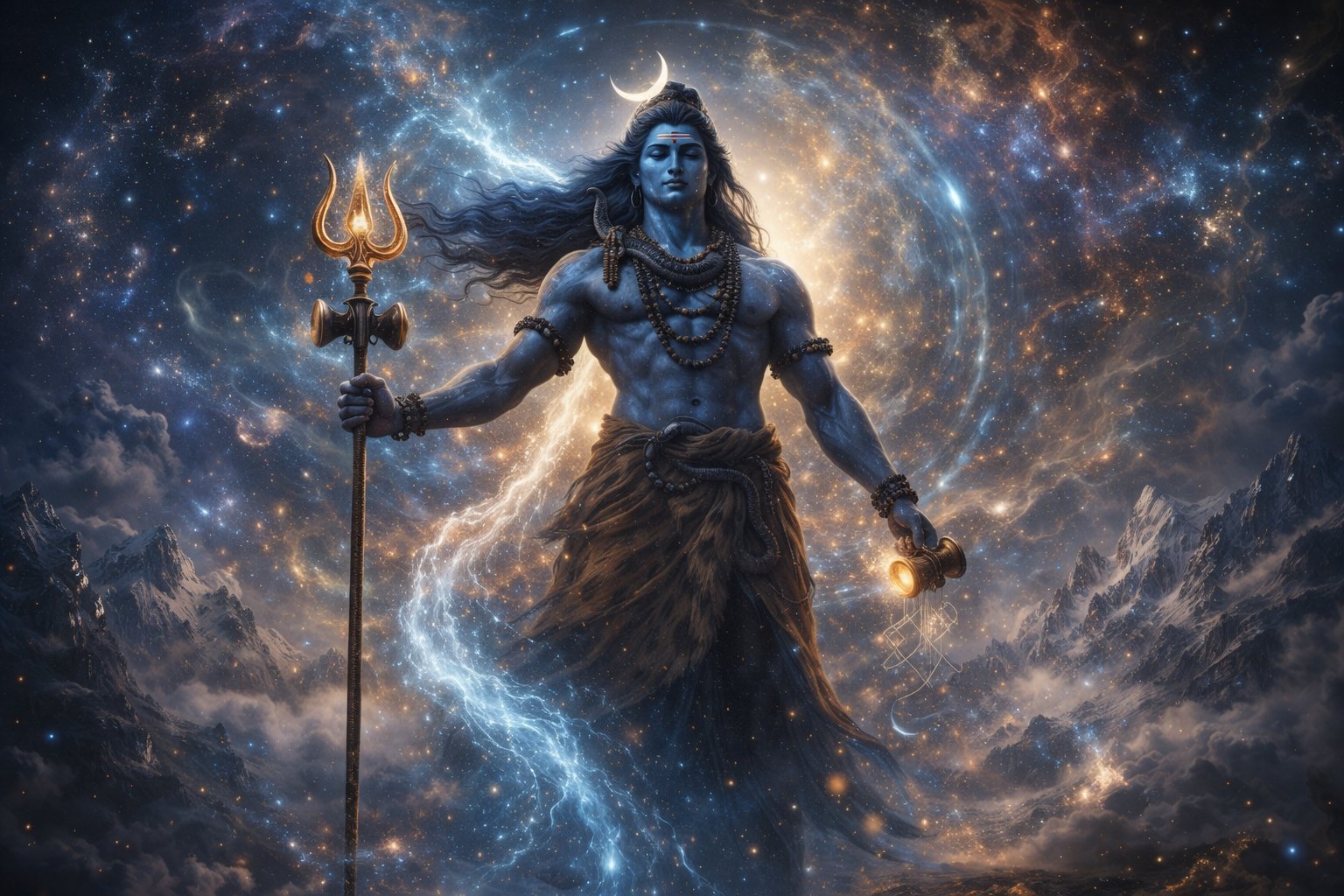
Who is Lord Shiva? The Many Names and Forms
Lord Shiva has 1,008 names according to the Shiva Sahasranama, each capturing a different aspect of his infinite nature. His most common names and their meanings reveal the extraordinary breadth of his divine personality:
- Mahadeva:The Great God, greatest among all deities
- Shankara:The giver of happiness and blessings
- Bholenath:The innocent, naive lord, easily pleased
- Pashupatinath:The lord of all beings (Pashus)
- Mahakala:The great lord of time and death
- Nataraja:The lord of the cosmic dance
- Adiyogi:The first yogi, who transmitted yoga to humanity
- Neelakantha:The blue-throated one, who swallowed the cosmic poison
The Shiva Purana, the primary scripture dedicated to Shiva, describes him as Svayambhu (self-created), Ananta (infinite), and beyond all the gods. Even Brahma and Vishnu are said to have been created from Shiva's cosmic form. In Shaivism, Shiva is not one of the gods. He is the Supreme Being himself, of whom all other deities are manifestations.
Shiva in the Trimurti: The Role of the Destroyer
In the popular Trimurti concept, Brahma is the creator, Vishnu is the preserver, and Shiva is the destroyer. But this is a profound misunderstanding if taken literally. Shiva does not destroy the way a vandal destroys, he dissolves the universe back into its source at the end of each cosmic cycle (Pralaya), making space for a new creation. He is the destroyer of ego, the destroyer of ignorance, the destroyer of death itself.
The Shiva Purana describes this cycle: Brahma creates the universe. Vishnu maintains it through countless divine interventions (avatars). And at the end of each Kalpa (a day of Brahma, approximately 4.3 billion years), Shiva performs the Tandava Pralaya, the cosmic dance of dissolution, returning all existence to the unmanifest state of Brahman.
गुणाश्रये गुणमये नारायणि नमोऽस्तु ते॥
Gunashraye gunamaye Narayani namostu te.
Lord Shiva's Appearance and Divine Symbols
Every element of Shiva's iconic appearance carries profound symbolic meaning:
- The Third Eye:The eye of wisdom that sees all, destroys all ignorance. When opened, it destroys even Kamadeva (the god of desire). It represents the Ajna Chakra, the centre of divine intuition.
- The Crescent Moon:Worn in his matted hair, representing his mastery over time (Soma = the moon = time). It also shows the waxing and waning of creation.
- The Ganga:The holy river flows from his matted locks (Jata), showing that he contains and controls the divine life force.
- The Trishula (Trident):The three prongs represent the three gunas (Sattva, Rajas, Tamas) and Shiva's mastery over creation, preservation, and destruction.
- Vibhuti (Sacred Ash):Smeared over his body, it represents the impermanence of the physical body and the truth that all will return to ash. It is also a reminder of the power beyond death.
- The Serpent Vasuki:Worn around his neck, representing conquered death and his mastery over Kundalini energy.
- Nandi the Bull:His vehicle and devotee, representing dharma, strength, and loyalty.
Shiva is the only god who is associated with both the highest austerity and absolute wildness, he meditates for eons and dances the wild Tandava. He lives in cremation grounds and in the holiest abodes. He wears skulls and is the protector of saints. He is the ultimate paradox, reminding us that the divine transcends all human categories.
Shiva as the Supreme Yogi: Adiyogi
According to the Agamic tradition, Shiva transmitted the science of yoga to humanity through the Saptarishis (seven sages) on the banks of Lake Kantisarovar, near the Himalayas. This event, described in the Yoga texts and Shiva Purana, makes Shiva the Adiyogi, the first yogi, the originator of the entire spiritual science of yoga.
Shiva himself is the supreme practitioner of yoga, sitting in eternal samadhi on Mount Kailash, with his mind absorbed in the Infinite. His body is covered in sacred ash (the body reduced to its essence). His eyes are half-closed in deep meditation. Time and space have no power over him.
The Shiva Sutras, a foundational text of Kashmir Shaivism revealed to Vasugupta in the 9th century, describe the nature of Shiva's consciousness as the ultimate ground of all existence. In this tradition, every individual consciousness is an expression of Shiva's infinite awareness.
The Marriage of Shiva and Parvati
The relationship between Shiva and Parvati is one of the most beloved stories in all of Hindu scripture. Parvati is the daughter of Himavan (the Himalaya mountain) and his wife Mena. She is the reincarnation of Sati. Shiva's first wife, who had immolated herself when her father Daksha insulted Shiva at a great yajna.
After Sati's death, Shiva withdrew into deep meditation on Kailash, his grief immeasurable. Parvati took birth with the sole purpose of winning Shiva back. She performed extraordinary austerities, standing in blazing heat, meditating in the cold Himalayan winter, until Shiva was moved by her devotion and accepted her.
The marriage of Shiva and Parvati represents the union of Purusha (pure consciousness) and Prakriti (divine energy), the cosmic marriage that underlies all of creation. Without Shiva, Parvati has no expression. Without Parvati, Shiva has no power to act. Together, they are the complete, dynamic divine reality, sometimes depicted as Ardhanarishvara, the half-male, half-female form of God.
The 12 Jyotirlingas: Shiva's Sacred Abodes
The 12 Jyotirlingas are the most sacred shrines of Lord Shiva, places where he is said to have manifested as a column of infinite light (Jyoti). A pilgrimage to all 12 is considered one of the most meritorious acts in Shaivism:
- Somnath:Gujarat (restored many times after destruction)
- Mallikarjuna:Srisailam, Andhra Pradesh
- Mahakaleshwar:Ujjain, Madhya Pradesh
- Omkareshwar:Madhya Pradesh
- Kedarnath:Uttarakhand (one of the Char Dham)
- Bhimashankar:Maharashtra
- Kashi Vishwanath:Varanasi, Uttar Pradesh
- Tryambakeshwar:Nashik, Maharashtra
- Vaidyanath:Deoghar, Jharkhand
- Nageshwar:Gujarat or Uttarakhand (debated)
- Rameshwaram:Tamil Nadu (established by Rama himself)
- Grishneshwar:Aurangabad, Maharashtra
Why Shiva is the Easiest God to Please
Among all the great deities of Hinduism, Shiva has a unique reputation: he is Ashutosh, the one who is quickly pleased (Ashutosh = "one who is delighted immediately"). While other deities may require elaborate rituals, Shiva is moved by sincere love alone.
The Shiva Purana tells countless stories of devotees, including demons, outcasts, and simple cowherd boys, who received Shiva's grace through nothing more than genuine, heartfelt devotion. Kanappa, a hunter who offered meat, water from his mouth, and his own eyes to the Shivalinga, acts that were ritually "impure", was among the greatest devotees Shiva ever honoured.
These five syllables, Na, Ma, Shi, Va, Ya, represent the five elements (earth, water, fire, air, space) and the five actions of Shiva (creation, preservation, dissolution, concealment, grace). Chanting "Om Namah Shivaya" is the simplest, most powerful, and most direct way to connect with Shiva's infinite grace.
Shiva does not ask for perfection, he asks for sincerity. He does not ask for external purity, he asks for internal surrender. He is equally the god of the saint and the sinner, the Brahmin and the outcast, the living and the dead. He is Shambhu, the cause of happiness, and his grace is available to all who call upon him with an open heart.
Har Har Mahadev! Om Namah Shivaya!