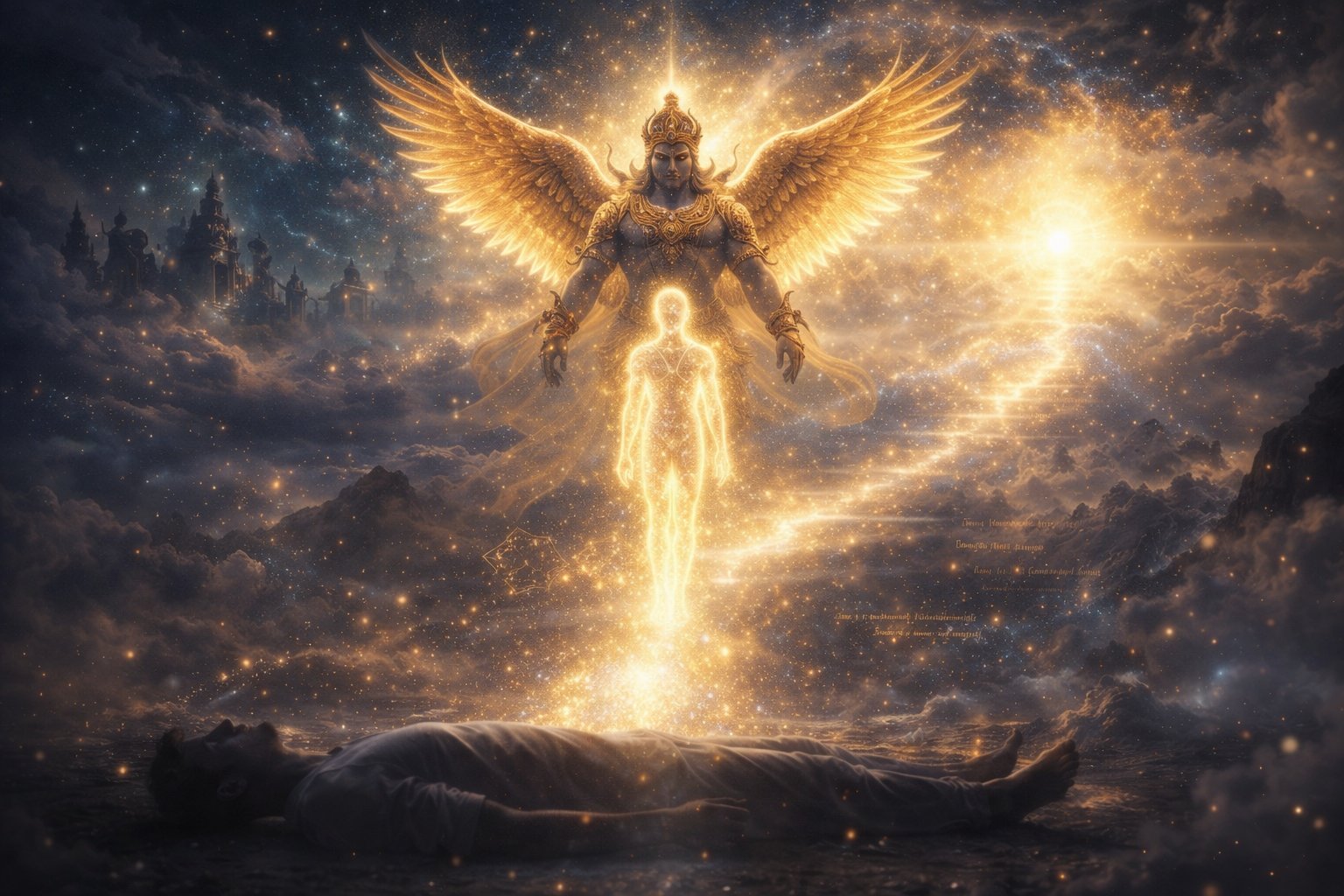
The Hindu Understanding of Death — The Atman Never Dies
The foundation of the Hindu understanding of death is laid out in complete clarity in the Bhagavad Gita by Lord Krishna himself:
न चैनं क्लेदयन्त्यापो न शोषयति मारुतः॥
Na chainam kledayantyapo na shoshayati marutah.
This is the bedrock of Hindu thought on death: the Atman — the true self — is indestructible. What dies is the physical body, which was always temporary. Death is compared in the Gita to changing clothes:
तथा शरीराणि विहाय जीर्णान्यन्यानि संयाति नवानि देही॥
Tatha sharirani vihaya jirnanyanyani sanyati navani dehi.
The Moment of Death — What Happens to the Soul
According to the Upanishads and the Garuda Purana, at the moment of death, the prana (life force) gradually withdraws from the body. The five senses dissolve one by one — touch, taste, sight, smell, and finally hearing. The last sense to leave is hearing, which is why it is considered so important to chant divine names (Ram, Om, Shiva) near the dying person.
The Katha Upanishad describes Yama (the god of death) sending his messengers (Yamadootas) to collect the soul. The soul, along with the subtle body (Sukshma Sharira — containing the mind, intellect, ego, and stored karma), departs the physical body.
The Bhagavata Purana and Garuda Purana state that what a person thinks of at the moment of death shapes their next birth. This is why the practice of chanting God's name continuously throughout life — so that it becomes natural at the moment of death — is so highly emphasised in all Hindu traditions.
This teaching — that the thoughts at death determine the next birth — explains why Hindus place such importance on dying in Kashi (Varanasi). It is said that Lord Shiva himself whispers the Taraka Mantra (the mantra of liberation) into the ear of anyone who dies in Kashi, granting them moksha regardless of their karma.
The 13-Day Journey After Death
After death, according to the Garuda Purana and the Grihyasutras, the soul undergoes a journey of 13 days before reaching the realm of Yama. During this period, the bereaved family performs specific rituals (Shraddha) to provide sustenance to the soul in its journey.
- Day 1 — The soul departs and begins its journey southward (Pitru Marga — the southern path leading to Yama's realm).
- Days 1–10 — The Pindas (rice balls) offered during the 10-day Dashagatra ritual are said to build the soul a new subtle body for its journey.
- Day 13 — The Sapindikaran ceremony unites the soul with its ancestral lineage (Pitru).
The Garuda Purana goes into extraordinary detail about this journey — the regions the soul passes through, the challenges it faces, and how the merit (punya) accumulated during its lifetime eases or complicates the journey.
The Role of Karma in Determining the Next Birth
The most fundamental factor in determining what happens after death is karma — the accumulated actions, thoughts, and intentions from the current and previous lifetimes. Hindu philosophy recognises three types of karma:
- Sanchita Karma — the total accumulated karma from all past lives. This is like a vast warehouse of seeds, most of which have not yet sprouted.
- Prarabdha Karma — the portion of Sanchita karma that is "ripe" and is being experienced in the current lifetime. This determines one's birth circumstances, body, and the broad strokes of one's life experiences.
- Kriyamana (Agami) Karma — the karma being freshly created through actions in this lifetime.
तं तमेवैति कौन्तेय सदा तद्भावभावितः॥
Tam tam evaiti kaunteya sada tadbhava bhavitah.
Heaven (Swarga) and Hell (Naraka) in Hindu Belief
Hindu scripture describes both heavenly realms (Swarga Loka) and hellish realms (Naraka or Patala) — but with a crucial difference from Abrahamic traditions: neither heaven nor hell in Hinduism is permanent. They are temporary realms where the soul experiences the results of its good or bad karma before returning to earth for another birth.
The Vishnu Purana and Garuda Purana describe 14 hellish realms (Narakas) with specific experiences matched to specific types of wrongdoing. Equally, the heavenly realms are described in detail — filled with light, music, divine beings, and the fruits of good karma.
The Bhagavata Purana says: "Even the gods in Swarga eventually exhaust their merit and fall back to earth. Only moksha — liberation from the cycle entirely — is permanent." This is why the goal of Hindu spiritual life is not heaven, but moksha — freedom from the entire cycle of birth and death.
Moksha — Liberation from the Cycle of Death and Rebirth
The ultimate answer to "what happens after death" in Hindu philosophy is Moksha — liberation. The soul that has fully dissolved all karma, realised the identity of Atman with Brahman, and transcended all attachment no longer takes birth. It merges with the infinite, eternal consciousness — like a river merging with the ocean.
Different traditions within Hinduism describe Moksha differently:
- Advaita Vedanta (Adi Shankaracharya) — Complete merging of the individual Atman with the universal Brahman. No individual identity remains.
- Vishishtadvaita (Ramanujacharya) — The soul retains its individual identity but dwells eternally in the presence of Vishnu in Vaikuntha.
- Dvaita (Madhvacharya) — The soul remains permanently distinct from God but enjoys eternal bliss in his presence.
This ancient prayer from the Upanishads captures the deepest aspiration of the Hindu soul — not mere survival after death, but complete liberation from the cycle of death and rebirth itself. Moksha is not something that happens after death — it is realised in this very lifetime, through wisdom, devotion, and the grace of God.
What the Garuda Purana Says About the Afterlife
The Garuda Purana is the primary Hindu text dealing with death, the afterlife, and the journey of the soul. It is traditionally recited during the 13-day period following a death in a Hindu household. Its descriptions are vivid, detailed, and occasionally frightening — serving as a powerful reminder of the consequences of unrighteous action during life.
Key teachings of the Garuda Purana:
- The soul travels 86,000 yojanas to reach Yama's realm, taking 47 days or one year depending on the soul's spiritual merit.
- Good actions (punya) ease the journey; bad actions (papa) make it difficult.
- Children who perform the Shraddha ceremonies for their parents provide crucial assistance to the soul in its journey.
- Giving food, water, and charitable donations on behalf of the deceased helps them in the other realm.
- The recitation of the Vishnu Sahasranama, Bhagavad Gita, and Garuda Purana near the deceased is believed to liberate the soul.
The Garuda Purana ultimately says: the best preparation for death is not ritual — it is dharmic living. A person who has lived righteously, served others, spoken truth, and cultivated devotion to God has nothing to fear at the moment of death. The Yama described in Hindu scripture is not cruel — he is the lord of justice, and justice is ultimately kindness.