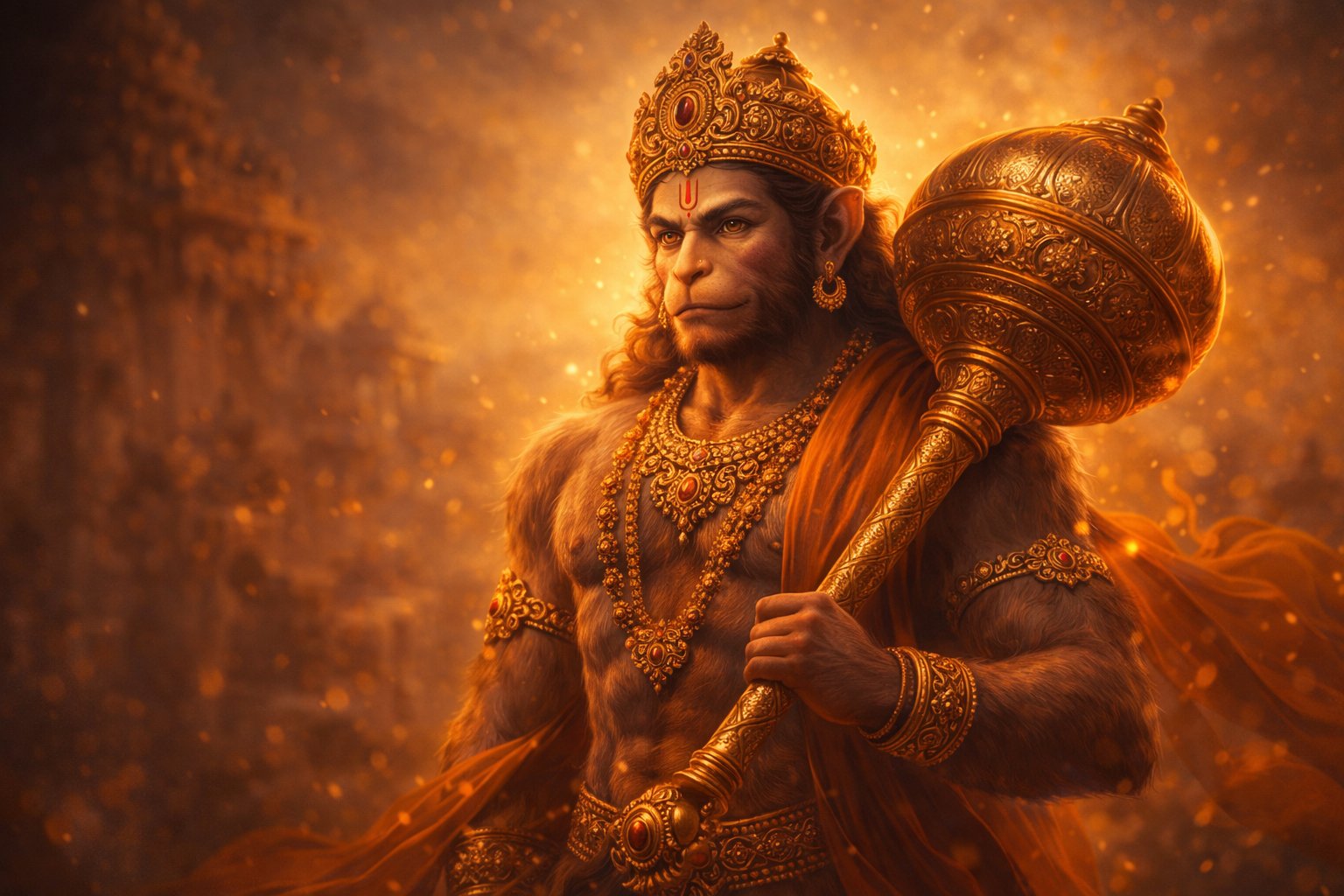
Bhishma's Divine Birth: Son of the Goddess Ganga
Bhishma was born as Devavrata, the eighth son of King Shantanu of Hastinapur and the Goddess Ganga herself. According to the Mahabharata, Ganga appeared to Shantanu in human form. They married on one condition. Shantanu would never question any of her actions. Ganga drowned seven of their children in the river (they were the seven Vasus, divine beings freed from human birth). When Shantanu finally could not bear to watch the eighth drowned, he stopped her. Ganga departed, but not before raising the eighth child, Devavrata, herself, in the heavenly realms.
Devavrata returned to his father as a young man of extraordinary ability. He had been educated by Parashurama himself in the art of warfare, and by Brihaspati in statecraft and the Vedas. He was perhaps the most complete human being of his era, brilliant, noble, capable, and deeply dharmic.
The Terrible Vow: How Bhishma Got His Name
King Shantanu, now aged, fell in love with Satyavati, the daughter of a fisherman. Satyavati's father refused to let her marry Shantanu unless her sons could inherit the throne, not Devavrata. Shantanu was too honourable to deprive his son of his birthright, so he suffered in silence.
Devavrata discovered the reason for his father's sadness. He went to Satyavati's father and renounced his claim to the throne. But the fisherman said: "What of your sons? Your sons may also claim the throne." And then Devavrata did the unthinkablehe took the most terrible vow in all of human history: he swore lifelong celibacy, forever renouncing marriage, children, and any personal future.
The gods themselves trembled. The earth shook. Flowers fell from the sky. The devas named him "Bhishma", "he of the terrible vow." From that day, Devavrata was known only as Bhishma.
राजपुत्रः स्वयं चाहं भीष्मः पितृवशानुगः॥
Rajputra svayam chaham Bhishmah pitruvashanuha.
He also received a boon from his father: Ichcha Mrityu, the power to choose his own moment of death. He would die only when he wished to.
Bhishma as Commander: The Greatest Warrior
Bhishma was made the Supreme Commander of the Kaurava army, 11 akshauhini strong, at the start of the Kurukshetra war. He declared he would fight for 10 days and kill 10,000 warriors per day. He fulfilled this declaration completely.
On the battlefield, Bhishma was virtually unstoppable. Even Krishna himself, who had vowed not to use weapons in the war, came close to breaking his vow on the tenth day as Bhishma's arrows rained down on the Pandava army. In rage, Krishna leaped from the chariot and charged at Bhishma with a chariot wheel, and Bhishma, seeing this, smiled and lowered his bow, saying: "I welcome death at the hands of the Supreme Lord."
Bhishma told his commanders: "I can kill all five Pandavas, but I will not. I will protect my duty to the Kaurava army without violating my love for the Pandavas. This is my dharma as I understand it." This tension, between competing dharmas, is the most sophisticated ethical dilemma of the entire Mahabharata.
The Paradox of Bhishma: Serving Adharma
Bhishma's greatest failing, and the source of the Mahabharata's most profound ethical inquiry, is his decision to fight for the Kauravas despite knowing they were wrong. When Draupadi was being disrobed in the Kaurava court, Bhishma sat in silence. When the Pandavas were cheated out of their kingdom through a fraudulent dice game, Bhishma remained seated. When Duryodhana refused to give the Pandavas even five villages, Bhishma counselled peace but ultimately deferred to the king's decision.
Why? Because of his vow, his absolute loyalty to whoever sat on the throne of Hastinapur. Bhishma had bound himself so completely that even when the king was wrong, he could not act against him. His greatest virtue, loyalty, became his greatest weakness.
This is the deepest lesson of Bhishma's story: a vow taken without wisdom can become a cage. Loyalty without discernment can become complicity in evil. The Mahabharata does not judge Bhishma harshly. It shows him as a deeply honourable man trapped by a decision made in a moment of noble impulse, without foresight.
Bhishma's Fall: The Stratagem of Shikhandi
The Pandavas, unable to defeat Bhishma by conventional means, approached him directly and asked him how he could be defeated. Bhishma, bound by his own dharma, told them the secret: he would not fight a woman or anyone born female in a previous life.
Shikhandi, who had been Amba (a princess whom Bhishma had wronged) in a previous life and had taken rebirth specifically to kill him, was placed in front of Arjuna. Bhishma lowered his bow. Arjuna, sheltered behind Shikhandi, released arrows that pierced Bhishma from every direction.
When Bhishma finally fell from his chariot, his body was held above the ground by the arrows piercing him. He lay on this bed of arrows for 58 days, waiting for the auspicious moment of Uttarayana (the sun's northward journey) to release himself from life.
The Vishnu Sahasranama: Bhishma's Gift to Humanity
As Bhishma lay on his bed of arrows, the entire court of Hastinapur gathered around him, including Yudhishthira, Krishna, and all the great sages. He gave humanity one of its greatest spiritual gifts: the Vishnu Sahasranama.
Yudhishthira asked Bhishma: "Who is the one Deity? Who is the one refuge? By glorifying whom can a man reach the auspicious? By remembering whom can a man be freed from fear?" Bhishma answered by reciting the 1,000 names of Vishnu, the Vishnu Sahasranama, which is still recited by millions of Hindus every morning to this day.
यः पठेच्छृणुयाद्वापि स लभेत् परमं पदम्॥
Yah pathecchrinuyad vapi sa labhet paramam padam.
Bhishma then departed, choosing his own moment of death, on the auspicious day of Uttarayana, with Vishnu's name on his lips. His death is described as the departure of a great liberated soul, honoured by gods and men alike.
The Dharmic Legacy of Bhishma Pitamah
Bhishma's legacy in Hindu dharma is immense and multi-dimensional. He is revered as a symbol of extraordinary self-sacrifice, absolute integrity, and unconditional loyalty. The day of Bhishma Ashtami, the day of his death, is observed as a sacred day across India, when offerings are made to the ancestors in his honour.
Yet his story also serves as a warning: the greatest dharma cannot be codified in a single rule. Life presents situations where competing dharmas collide, where loyalty fights with righteousness, where personal vows conflict with universal duty. Bhishma chose to honour his personal vow even at the cost of universal dharma. The Mahabharata does not say this was right. It shows the consequences.
धर्मे धर्मविदां श्रेष्ठस्तं न हिंस्यात्कदाचन॥
Dharme dharmavidam shreshtham tam na himsyat kadachana.
This verse, from the very Shanti Parva where Bhishma teaches Yudhishthira, contains the irony of Bhishma's life. He knew this truth. He taught it beautifully. And yet he could not always live it. He is not a hypocrite. He is, rather, a profoundly human figure: someone who knew the right thing but was trapped by the choices of his past. In this, Bhishma is perhaps the most relatable great soul in all of Hindu scripture.